
A practical way to sort AI risk before you measure it
It seems like every risk program is scrambling to get their arms around AI risk. It reminds me of when cloud was the hot topic, only moving much faster and with bigger consequences if we get it wrong. AI has been commercially available for several years now, and I still see it as an emerging risk. Our understanding of the implications is evolving every day, and it certainly doesn’t feel like business as usual to manage it.
So if every risk program is being asked by its leaders to assess AI risk, what techniques have evolved to help us? The first step should be defining what we even mean by AI risk. Is it the risk of adopting generative AI too quickly, without reasonable safeguards?
Many organizations are just as worried that they’ll fall behind their peers by adopting too slowly, or invest in places that never produce a return. The security community is worried about AI-powered attackers chaining exploits at machine speed. And then there are the larger societal concerns about the global AI arms race. All of these are valid, but for someone tasked with producing an AI risk assessment, the breadth of the topic is daunting.
How others sort AI risk
Luckily, many professional organizations and consultancies have offered frameworks to help us categorize AI risks. I’ve heard many executive discussions gravitate toward three buckets of risk, along the lines of NIST’s draft Cyber AI Profile1:
- Securing AI System Components (Secure)
- Conducting AI-Enabled Cyber Defense (Defend)
- Thwarting AI-enabled Cyber Attacks (Thwart)
That framing works well from the cybersecurity professional’s perspective, but it misses all the operational errors that can occur when we build and run AI.
Canada’s Top 10 AI Security Actions2 use three pillars too, but different ones:
- Protecting against adversarial use of AI
- Protecting AI systems
- Protecting users and business processes
The third pillar covers shadow AI, data privacy in prompts, human-in-the-loop oversight, drift, hallucination, bias, and over-reliance. Those are important parts of operational execution.
Deloitte organizes gen AI risk into four categories, framed around a survey of nearly 1,200 cyber leaders3:
- Risks to the enterprise, which include threats to organizational operations and data
- Risks to gen AI capabilities, which include the potential for AI systems to malfunction or their vulnerabilities to be misused
- Risks from adversarial AI, which include threats posed by malicious actors leveraging gen AI
- Risks from the marketplace, which include economic, legal, and competitive pressures that could influence AI deployment and security
The MIT AI Risk Repository4 takes a different approach. It is a living database of more than 1,700 AI risks drawn from 74 frameworks, and it classifies each one two ways. Its domain taxonomy sorts risks into seven areas, such as privacy and security, misinformation, and malicious actors and misuse. Its causal taxonomy asks whether a risk was caused by a human or by the AI, whether the outcome was intentional or unintentional, and whether it happens before or after deployment.
That causal view is the closest thing I’ve found to sorting AI risk by cause, and the repository is an invaluable research resource. It was built to organize the research literature, though, not to scope a single organization’s assessment. Its definition of intent is about whether an outcome was expected when someone pursued a goal, not whether someone deliberately misused a system. And it doesn’t distinguish our AI from someone else’s.
In October, the Monetary Authority of Singapore published its Guidelines on AI Risk Management5. MAS treats AI as something that amplifies the risk types financial institutions already manage: financial, operational, conduct, financial crime, and reputational. That sorts risk by consequence, which complements sorting by cause. MAS also scopes the guidelines to the institution’s own AI and leaves cyber threats from others’ AI to separate papers.
Interesting side note: every one of these frameworks that covers someone else’s AI being used against us gives it a category of its own. MAS leaves it out of scope entirely, which is the same boundary I drew for the AI Risk Map™. This isn’t an exhaustive survey, but it’s a strong indication that “their AI” deserves to stand on its own.
What none of them has is a place for getting the AI strategy itself wrong.
Moving too slowly, betting on hype, or spending without any way to tell what it returned doesn’t have a home in any of them. In my conversations with executives, that is often the first thing on their minds when they ask about AI risk.
I have tried using these industry frameworks in my own risk work, and each one either misses part of the risk or doesn’t line up with well-defined risk scenarios. Most of them were built for a different job: organizing a security program, prioritizing actions, setting a cyber strategy, or cataloging research. They do that job well. Assessing risk needs different categories.
Four kinds of AI risk
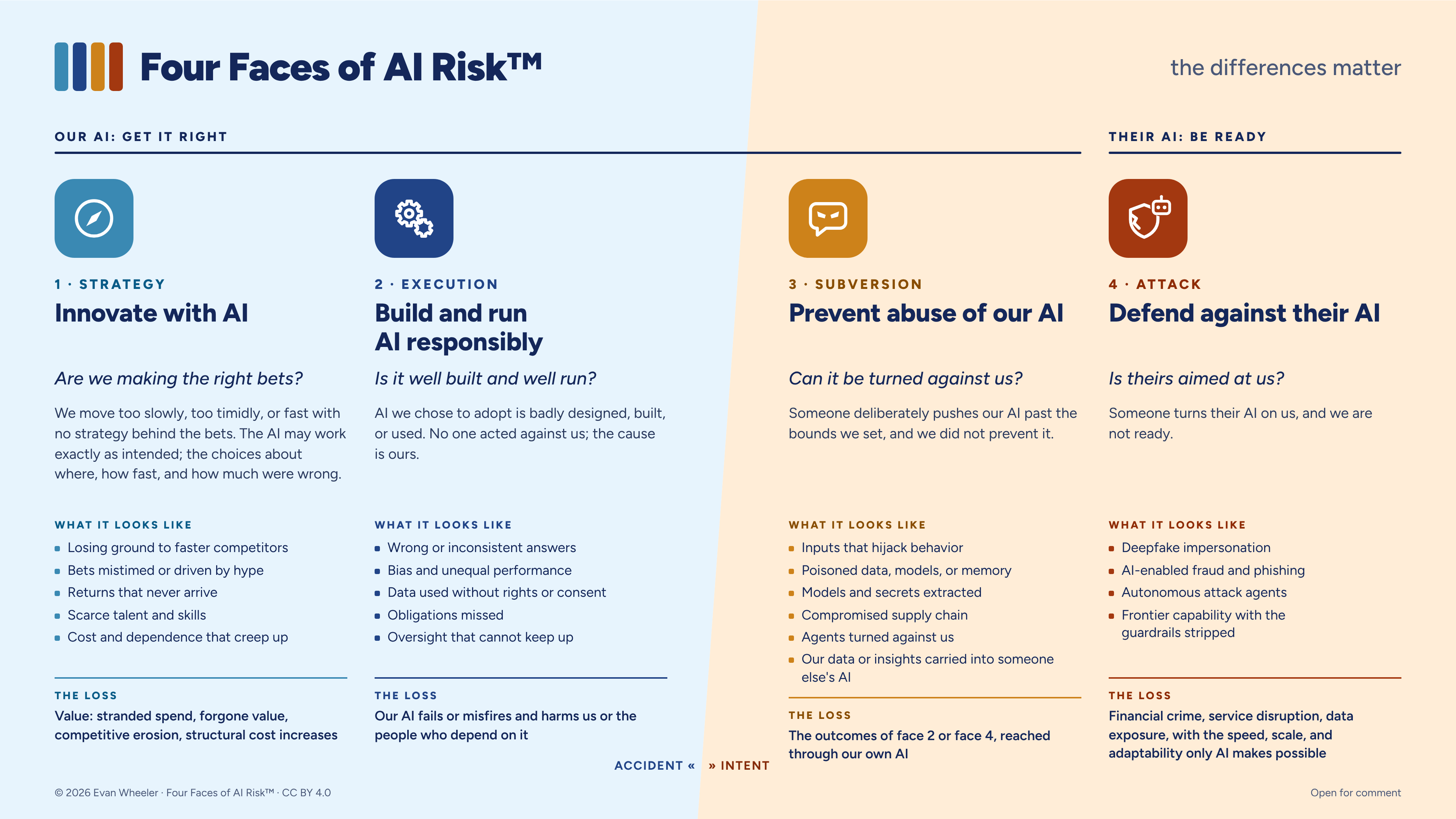
So I’m proposing a different approach, derived from a few structural questions and tested against every risk factor on my AI Risk Map. I think about AI risk as four kinds:
- Innovate with AI (Strategy). We move too slowly, too timidly, or fast with no strategy behind the bets. The AI may work exactly as intended. The choices about where, how fast, and how much were wrong.
- Build and run AI responsibly (Execution). AI we chose to adopt is badly designed, built, or used. No one acted against us, and the cause is ours.
- Prevent abuse of our AI (Subversion). Someone deliberately pushes our AI past the bounds we set, and we didn’t prevent it.
- Defend against their AI (Attack). Someone turns their AI on us, and we aren’t ready.
I call these the Four Faces of AI Risk™. The first three are about our AI, and the job is to get it right. The fourth is about theirs, and the job is to be ready. Looked at another way, the first two are things we do to ourselves, and the last two are things someone does to us, either with our AI or with theirs.
No one acts against us


Someone acts deliberately


A structure your CFO already uses
These four faces are built to support risk assessments, but they also need to be easy for the business to pick up. The groupings have to work for us analytically, and they have to become part of how the business talks about AI in everyday conversations.
The easiest way I’ve found to explain this to executives is to borrow a structure they already use. Finance leaders already govern every major asset through four separate conversations. They just don’t call it a risk taxonomy.
Think about a big capital asset, like a new manufacturing line.
- Did we invest in the right asset, at the right time, at the right scale? That’s capital allocation, and choosing not to invest is a decision too.
- Is it performing the way we planned? When it isn’t, nobody meant it to fail. That’s operating error.
- Is someone using our asset for their own gain? Auditors have a word for that: misappropriation.
- Are we ready for the shocks we can’t prevent? That’s an external threat, and we hedge, insure, and plan for continuity.
Each of those conversations has its own oversight, its own review cadence, and its own data. Nobody would ask for one number called “the risk of the manufacturing line.”
AI is one more asset that needs all four conversations: investment, error, misappropriation, external threat. They line up with the four faces one to one.
The line between error and misappropriation will be familiar to any audit committee. Auditors have separated misstatements caused by error from those caused by fraud for decades9, and the deciding factor is intent. That’s the same line I draw between building and running AI badly and someone abusing it.
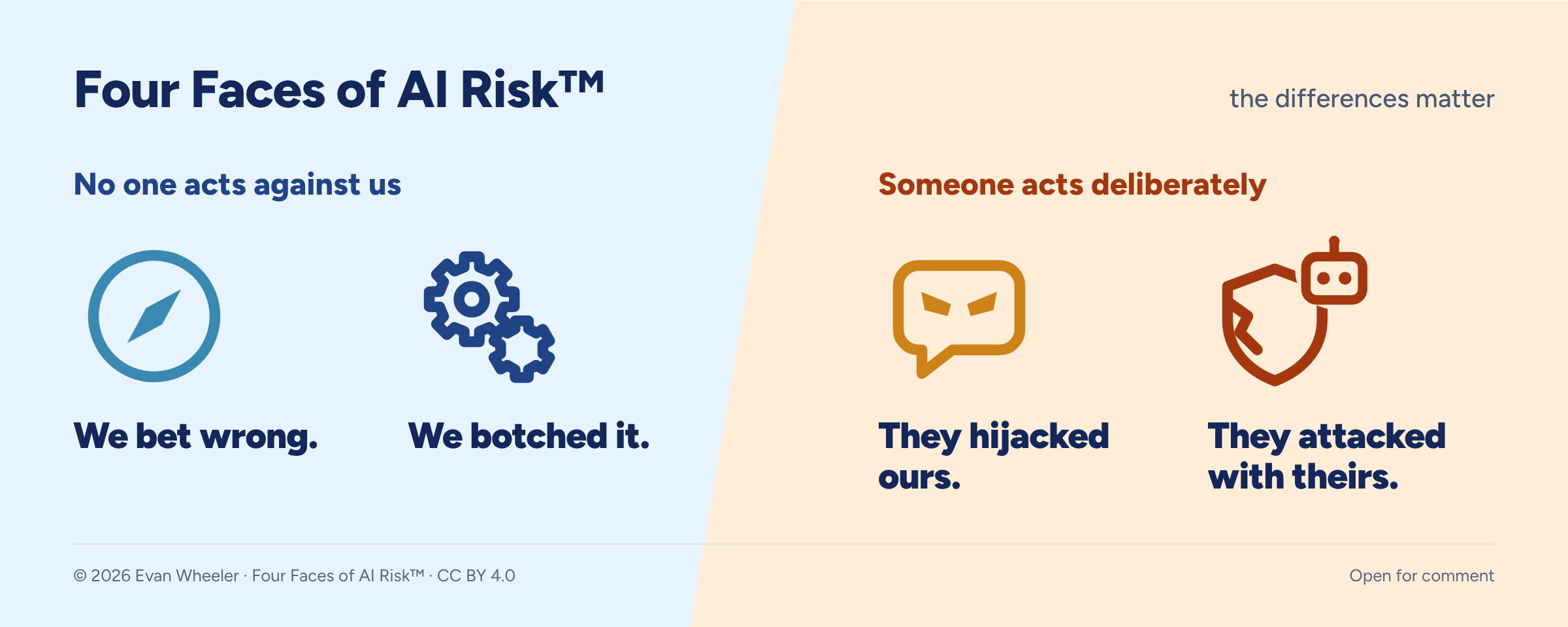
For everyday conversation, the shorthand is blunter still: we bet wrong, we botched it, they hijacked ours, or they attacked with theirs.
No one acts against us
Someone acts deliberately
Why the differences matter
So why does this matter for a risk assessment?
Take the AI fear I hear most often: customer data gets exposed through AI. In a direction-based framing like Deloitte’s, that’s a risk to the enterprise. One category, one line on the register.
When I try to scope it as a scenario, I hit a wall right away. What actually caused the exposure?
- An employee pasted customer records into a public chatbot.
- A model memorized training data and repeated it to the wrong user.
- An attacker injected instructions that made our customer service agent hand over data.
- A partner loaded insights about our customers from our AI into their own AI and used them past the terms we set.
- An attacker used AI-written phishing to steal credentials and pull the data.
- We banned AI on customer data out of unfounded fear, while competitors adopted it with sound controls.
That’s one line on the register and six different scenarios. They happen at different rates, they draw on different data, and they’re stopped by different controls. Average them into one estimate and you get a number nobody can act on. It overstates the attacker for the team managing employee behavior, and understates it for the team defending the agent.
The four faces force that split before the analysis starts. The pasting employee and the regurgitating model are execution: our AI, and nobody meant it. The injected agent is subversion, because someone pushed our AI past its bounds on purpose. So is the partner, even though the AI doing the work is theirs. What they misused was ours. The phishing campaign is an attack with their AI.
The ban is strategy, and it’s the one that surprises people. Nothing failed and nobody attacked us, yet the fear itself produced the loss. Each of the six becomes its own scenario with a clear threat community, an owner, and a set of controls to evaluate.
That’s the property I was looking for. Each face tells you who or what has to act for the loss to happen, which is most of what drives frequency, before you’ve gathered a single data point. In FAIR terms, it separates the threat communities at intake rather than after the estimate goes sideways.
Three questions place any AI risk
Placing a risk takes three questions, asked in order:
- Whose AI? If it’s theirs, aimed at us, it’s face 4.
- Ours. Did someone deliberately push it past the bounds we set? If yes, it’s face 3. The test is deliberate action. A curious user who jailbreaks our agent counts, even with no malice involved.
- No. Where did it go wrong? In the bets we made, it’s face 1. In how it was built or run, it’s face 2.
To be fair to Deloitte’s model, it was built to organize a cyber strategy, and it does that job well. Its categories tell you where a risk lands. For scoping a scenario, I need the answer to an earlier question: what would have to be true for this loss to happen?
Putting it to work on the AI Risk Map
The framing has also proven useful on the AI Risk Map I published in September.
Someone who had been using the AI Risk Map in their own risk work sent me a note about abliteration6, a technique for removing the safety training from an open-weight model by editing the model weights directly. A jailbreak tries to get around guardrails that are still in place. An abliterated model no longer has those guardrails at all.
The note raised two concerns at once. One was that criminals could use abliterated models to build attack capabilities more cheaply. The other was that organizations could end up running models whose safety training has been stripped or weakened without realizing it.
When I ran those concerns through the four faces, they landed in different places. Criminals using abliterated models is their AI aimed at us, so it belongs on the threat register, and the AI Risk Map leaves it out on purpose. An organization running a self-hosted or fine-tuned model without the safety behavior it assumes it has is our own AI being built and run badly, and that wasn’t on the AI Risk Map yet.
It also doesn’t require an attacker. Research has shown that fine-tuning a model on ordinary, benign data can weaken its safety alignment7, and NIST’s Generative AI Profile8 already recommends verifying that fine-tuning hasn’t compromised safety and security controls. The standards had noticed this problem before my AI Risk Map did, so it has been added in a recent release.
The full framework is on the Four Faces page, free to use under CC BY 4.0. It includes the edge rules that settle the harder cases, more worked examples, and a version of the guide written so you can load it into your own AI assistant and have it sort your risk register.
First published 2026. © Evan Wheeler. All rights reserved. Four Faces of AI Risk™ is a trademark of Evan Wheeler. Written against Four Faces of AI Risk v1.0.
1. National Institute of Standards and Technology, Cybersecurity Framework Profile for Artificial Intelligence (Cyber AI Profile), NIST IR 8596, initial preliminary draft, December 2025. ↩
2. Canadian Centre for Cyber Security, Top 10 artificial intelligence security actions: A primer, ITSAP.10.049, 2026. ↩
3. K. Norton et al., “How can tech leaders manage emerging generative AI risks today while keeping the future in mind?”, Deloitte Insights, February 2025, drawing on Deloitte’s Global Future of Cyber Survey. ↩
4. P. Slattery et al., The AI Risk Repository, MIT FutureTech, 2024, updated regularly. ↩
5. Monetary Authority of Singapore, Guidelines on Artificial Intelligence Risk Management for Financial Institutions, October 2026. ↩
6. A. Arditi et al., “Refusal in Language Models Is Mediated by a Single Direction”, NeurIPS 2024. Abliteration builds on this result. ↩
7. X. Qi et al., “Fine-tuning Aligned Language Models Compromises Safety, Even When Users Do Not Intend To!”, ICLR 2024. ↩
8. National Institute of Standards and Technology, Artificial Intelligence Risk Management Framework: Generative Artificial Intelligence Profile, NIST AI 600-1, July 2024. ↩
9. PCAOB, AS 2401, Consideration of Fraud in a Financial Statement Audit, paragraph .05; the international equivalent is ISA 240. ↩